
Creating Superhuman Productivity
Tools, Systems, and Phycology That Power High Achievers


When you break down any world-class achievement like Miles Davis composing a timeless track, a skyscraper rising into the skyline, or a cure being discovered in a lab you’ll find the same foundation.
Productive people, working with focus and purpose.
Not talent alone.
Not vision alone.
Relentless, sustained output.
And here’s the truth that most people ignore:
Productivity isn’t a hack.
It’s the daily heartbeat of success.
Why Productivity Matters So Much
You already know the feeling:
On your most productive days, you feel energized, confident, and on track.
On your least productive days, even simple tasks feel heavy and self-doubt creeps in.
This isn’t just a feeling. It’s backed by science.
A 2021 study published in Frontiers in Psychology found that task completion boosts dopamine levels, increasing both satisfaction and motivation for future tasks.
Meanwhile, researchers at the University of Sheffield discovered that perceived productivity directly affects self-esteem and subjective well-being.
In other words, when you consistently finish what matters, you feel better about your work and yourself.
Goal Setting Backed by Science
Setting big goals is inspiring until you wake up and realize you don’t know where to start.
The problem? Most goals are too vague or too distant to generate daily motivation.
Enter the concept of implementation intentions. This technique is supported by over 90 studies and meta-analyses (Gollwitzer & Sheeran, 2006).
These are clear “if-then” statements:
“If it’s 9am, then I will start writing.”
“If I finish my calls, then I will take a 10-minute walk.”
You can combine this with goal chunking which is turning a long-term goal into small, bite-sized sprints.
Instead of “write a book,” try:
Write 300 words before lunch.
Finish a chapter draft by Friday.
Share a paragraph with a friend for feedback.
This builds what researchers call self-efficacy and the belief that you can achieve your goals one chunk at a time.
Prioritization: The Eisenhower Matrix
“What is important is seldom urgent, and what is urgent is seldom important.”
—Dwight D. Eisenhower
The Eisenhower Matrix helps you cut through chaos. It categorizes tasks into four quadrants:
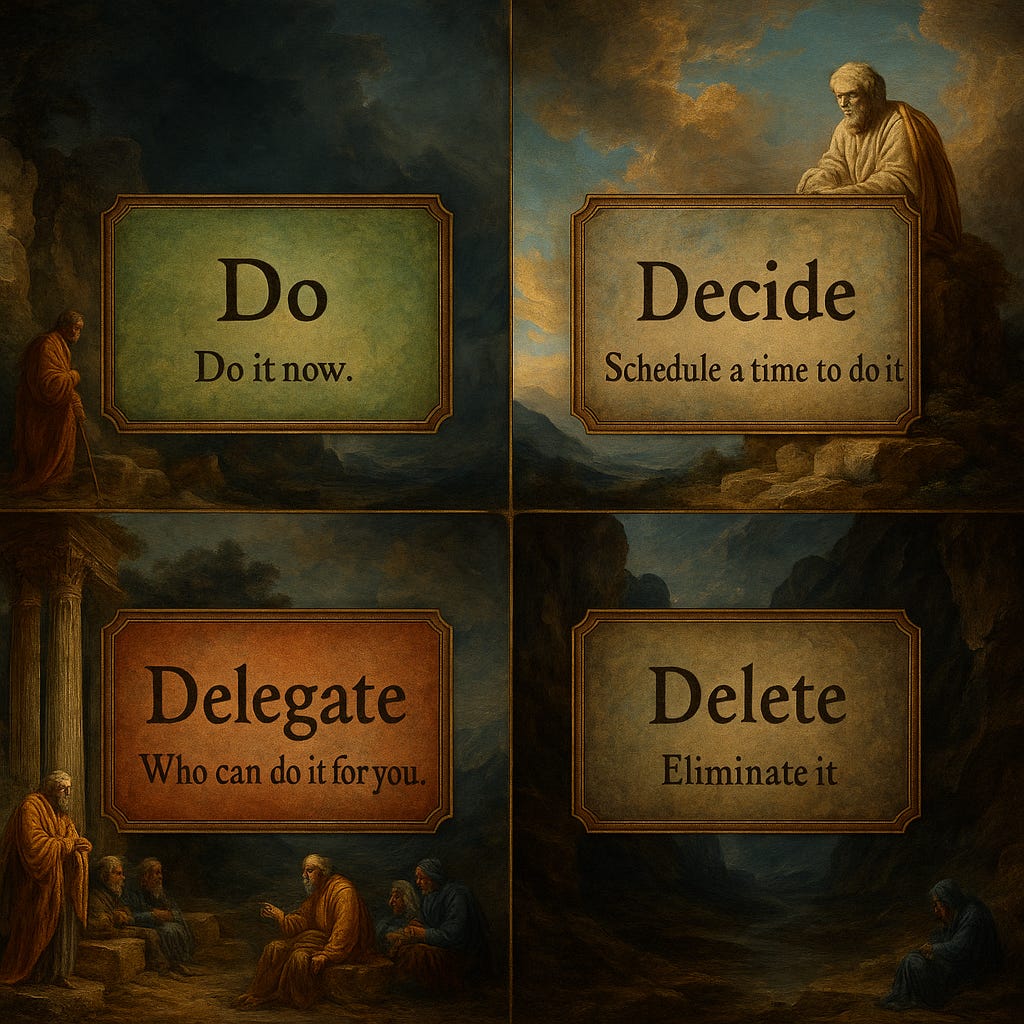
A study from Harvard Business Review revealed that high-performers consistently spend more time on Quadrant II tasks (important but not urgent), like skill development and strategic planning.
The key? Don’t just work harder, work on the right things.
Focus and Doing Deep Work
Cal Newport coined the term Deep Work as:
“Professional activity performed in a state of distraction-free concentration that pushes your cognitive capabilities to their limit.”
It’s not just philosophy.
Studies from the University of California, Irvine found that after a distraction, it takes an average of 23 minutes and 15 seconds to return to the original task. That’s your day, sliced into bits.
To enter deep focus:
Silence all notifications (yes, all of them).
Use the Pomodoro Technique:
25 minutes of focused work
5-minute break
After 4 sessions, take a longer 15–30 minute break.
This method works because it activates the Zeigarnik Effect. Your brain wants to finish what it started, so short timed bursts keep momentum high.
Try tools like Focus Booster or Forest to time your Pomodoros and gamify your attention span.
Continuous Learning is Your Productivity’s Hidden Engine
Your productivity is only as sharp as your knowledge.
The “Learn–Do–Teach” model (popularized by Naval Ravikant and others) reminds us:
If you’re not feeding your mind, your output will eventually stagnate.
Different learning formats feed different parts of your brain:
Formal Learning: Online courses, certifications (e.g., Coursera, LinkedIn Learning)
Social Learning: Podcasts, masterminds, mentorship, community feedback
Self-Directed Learning: Reading, writing, experimenting
A meta-study published in Review of Educational Research (2017) shows that active learners (who teach back or reflect) retain 2–3x more information than passive learners.
Translation?
Make learning an active part of your workflow.
Curiosity is not a luxury, it’s your fuel.
Energy Management is an Undervalued
Forget time management.
What you really need is energy management.
A 2022 study from Nature Reviews Neuroscience confirmed what athletes already know:
Your brain has limited attentional resources.
If you don’t rest or rotate tasks, performance drops sharply.
That’s why elite performers:
Work in sprints, not marathons
Get sunlight in the morning (regulates circadian rhythm)
Take walking breaks to reset dopamine and serotonin
A simple practice?
Use The Daily Highlight (from the book Make Time by Knapp & Zeratsky):
Each morning, choose one task that will make the day feel like a win.
Everything else is bonus.
Productivity Reflects Who You Are
Productivity isn’t a measure of how much you can do.
It’s a reflection of who you are becoming.
When you consistently:
Set aligned goals
Prioritize what matters
Protect your focus
Keep learning
Manage your energy
You’re not just getting more done.
You’re becoming the type of person who finishes what they start.